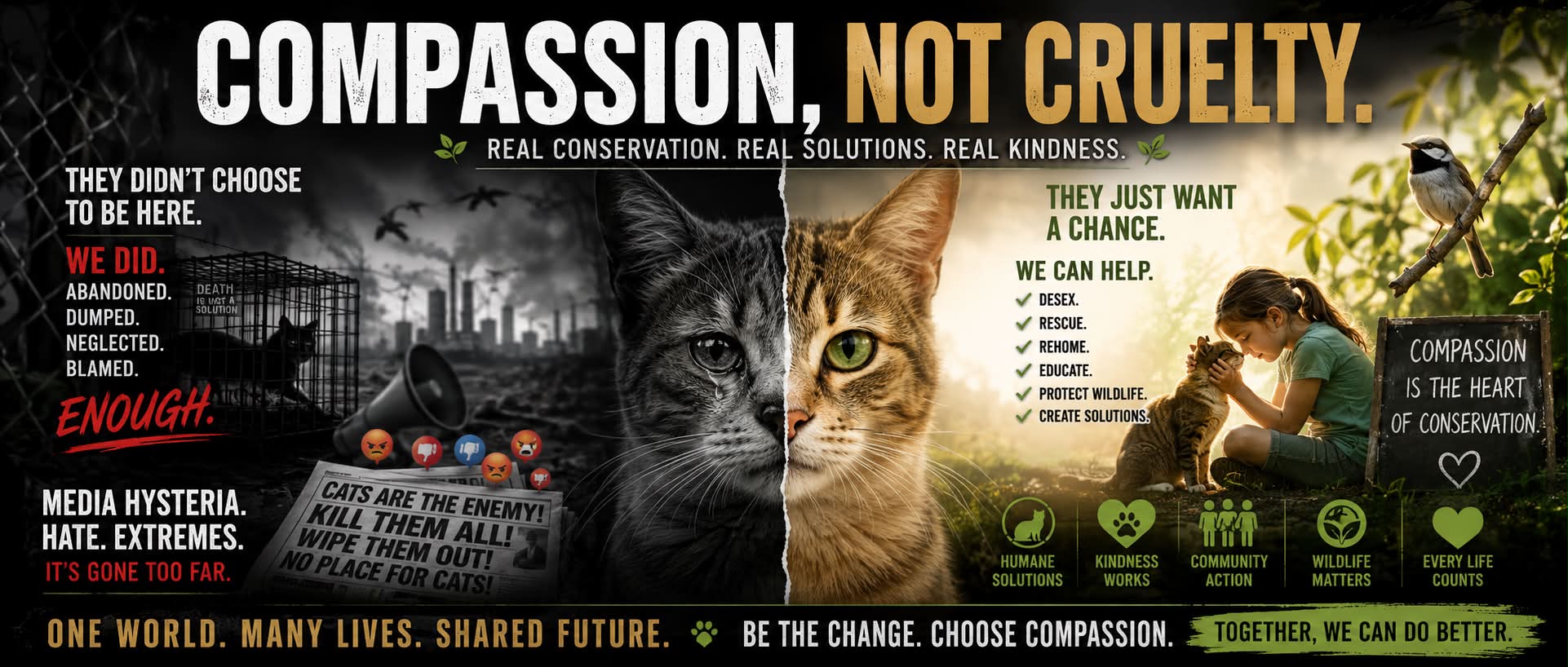
When Compassion became Controversial
When Compassion Became Controversial
There was a time when most people saw a cat and simply saw a cat.
A creature that shared our homes, curled in sunny windows, purred on cold nights, and sometimes survived against incredible odds on the streets. Cats were loved, pitied, admired, or occasionally ignored. But they were rarely hated.
Then something changed.
As conservation concerns grew, the conversation around cats began to shift. At first, it seemed reasonable enough. Scientists studied wildlife declines. Conservationists raised concerns about predators. Communities discussed how to protect vulnerable species.
These were important conversations. But somewhere along the way, the discussion stopped being about balance and solutions. It became about blame.
Headlines became more dramatic. Social media rewarded outrage. Nuanced discussions were drowned out by shocking claims and emotional arguments. Cats were increasingly portrayed not as animals following their instincts, but as villains responsible for every environmental problem.
People who cared for stray cats found themselves accused of harming wildlife simply because they offered food to a hungry animal. Volunteers who spent their own money desexing cats were criticised rather than supported. Rescue groups were labelled part of the problem despite preventing thousands of unwanted litters.
The language became harsher.
What had once been discussions about management and responsibility became calls for eradication. Compassion was dismissed as weakness. Anyone who questioned extreme measures was accused of caring more about cats than native species.
Yet lost in the noise was a simple truth. Cats did not create themselves. They did not decide to be abandoned. They did not choose to be dumped at rubbish tips, left behind when families moved, or born into generations of neglect. They did not write the policies, build the cities, clear the forests, or introduce themselves to countries where they did not originally exist.
Humans did all of that. And now, rather than accepting responsibility, many preferred to place all the blame on the animals least capable of defending themselves.
The irony was that the people working hardest to help cats were often the same people advocating for practical solutions. They supported desexing programmes. They worked to reduce populations humanely. They spent countless hours trapping, treating, and rehoming animals so that fewer cats would be born into lives of hardship.
Their goal was not endless colonies. Their goal was fewer homeless cats. Yet they often found themselves attacked from both sides. Too compassionate for those demanding lethal solutions. Too realistic for those unwilling to acknowledge ecological concerns.
Meanwhile, the cats remained exactly what they had always been. Animals. Not evil. Not malicious. Not masterminds of environmental destruction. Just animals trying to survive.
The tragedy of the debate is not that people care about wildlife. We should care deeply about wildlife. The tragedy is that somewhere along the way, caring about wildlife became, for some, a justification for abandoning compassion.
As if concern for one species required hatred of another. But true conservation has never been about cruelty. True conservation is about responsibility.
It is about recognising that environmental problems are complex, that ecosystems matter, and that suffering matters too. It is about finding solutions that reduce harm wherever possible rather than celebrating it when it occurs. Because a society should be judged not only by how it protects its most vulnerable wildlife, but also by how it treats its most vulnerable animals.
And perhaps one day we will remember that compassion is not the enemy of conservation.
It is the thing that makes conservation worth fighting for in the first place.